What are the benefits of tea tree oil for skin?
01
Loading page…
Loading ingredient guide…
Skincare, simply explained
Tea tree oil is used in skincare for blemish-prone skin and has a fresh herbal scent. Learn what it does, how to use it, and what to look for in a finished facial product.
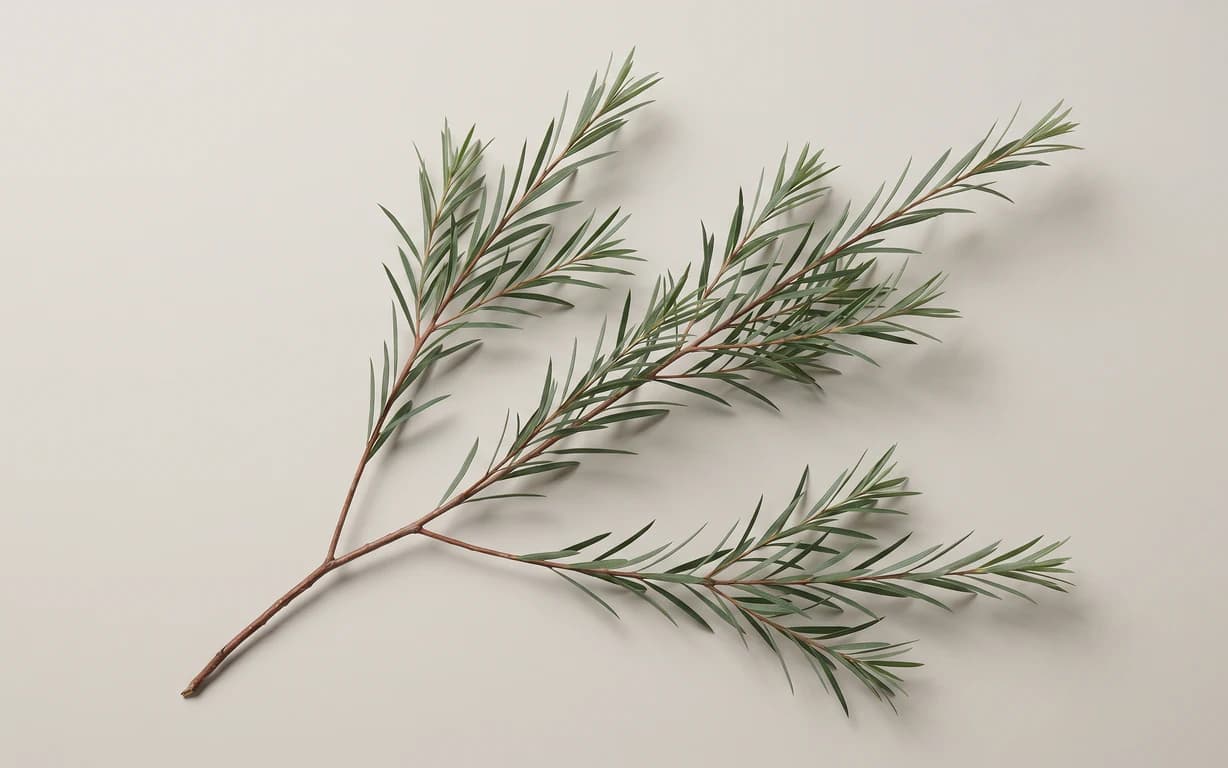
A controlled study found fewer blemishes with a purpose-made tea tree gel over several weeks. This is the main reason tea tree oil gets attention in acne research.
Tea tree oil gives some formulas their distinctive aromatic scent. If you enjoy that finish and your skin tolerates fragrance, it may be part of the appeal.
Tea tree oil is an essential oil obtained from Melaleuca alternifolia, a plant native to Australia. Steam distillation releases the aromatic oil from its leaves and small branch tips. Despite the similar name, this plant is different from Camellia sinensis, which gives us green tea.
The oil contains a mixture of fragrant plant compounds, including terpinen-4-ol. This composition gives tea tree its distinctive herbal scent and helps explain its place in blemish-focused skincare research. It is an aromatic essential oil, rather than the kind of fatty seed oil used mainly to add richness to a moisturizer.
Tea tree leaf water and leaf extract are separate preparations from the same plant. For skincare containing the essential oil, look for the leaf-oil name in a finished facial product.
On the ingredient list: Melaleuca Alternifolia (Tea Tree) Leaf Oil or Melaleuca Alternifolia Leaf Oil.
Also known as: Tea tree oil, tea tree essential oil.
Choose a finished skincare product made for facial use. Do not apply undiluted tea tree essential oil.
Patch test first, then apply only as the label directs. A rinse-off cleanser and a leave-on product need different routines.
Keep the rest of the routine gentle, with a comfortable moisturizer. Introduce other active products separately.
Avoid the eyes, keep the container closed and store it as directed. Use sunscreen as your final morning step.
Keep a tea tree routine simple. Choose gentle hydrating and moisturizing products around it, especially when your skin is prone to dryness.
Researchers compared a tea tree gel with a gel base in people with mild to moderate acne. Over 45 days, the tea tree formula improved both blemish counts and overall acne severity.
The evidence gives tea tree a place in the conversation about blemish care. For persistent acne, a targeted treatment plan is more useful than repeatedly trying stronger essential oils.
There is some evidence for particular tea tree formulas, including a controlled gel study. Overall research is still limited. If acne persists, a dermatologist can help you choose an established treatment that fits your skin.
Avoid applying undiluted essential oil. Choose a finished facial product and follow its directions instead of mixing your own concentration.
Only as the product directs and while it feels comfortable. Do not keep using it through burning, itching or a rash.
A controlled acne trial and limited wider research support interest in particular topical tea tree formulas. Product preparation and skin tolerance matter; undiluted oil is not the tested consumer routine recommended here.
The acne trial involved 60 participants using a specific 5% gel for 45 days. That concentration describes the study, not a DIY recipe or a recommendation to seek the strongest product. Research does not establish equal results for cleansers, leaf water or every cosmetic formula.
2007-01 · DOI 10.4103/0378-6323.30646
A placebo-controlled study of a purpose-made gel in 60 people. It supports interest in the tested formula, not undiluted oil, homemade mixtures or every tea tree cosmetic.
2025-04
Summarizes the limited acne evidence, the risk of skin irritation and the importance of never swallowing the oil. Older oil exposed to heat, light or air may be more likely to cause reactions.
2026-07-02 · DOI 10.1177/10915818261460875
Evaluates tea tree ingredients under cosmetic conditions of use. Safe formulation and avoiding sensitization are central to its conclusion; concentrated essential oil is not interchangeable with a finished facial product.
It can be irritating or cause contact allergy, so it is not an automatic choice for sensitive skin. If fragrance or essential oils bother you, choose a routine without it.
Be cautious about adding several potentially irritating products at once. Start with the directions for your acne or retinol product and a simple moisturizer. There is no need to add tea tree oil if your routine is already working.
No. Leaf oil, leaf water and leaf extract are separately named ingredients. Research on a tea tree oil gel does not tell us that a leaf-water toner will do the same thing.
2021-03
Table 1 distinguishes leaf oil, leaf water and extracts, and lists leaf oil’s fragrance function. This earlier report is used for ingredient definitions; the later published assessment supplies the safety conclusion.
2021-08-10
Dermatologists explain how to try a finished skincare product on a small area before using it more widely.
Find your next routine favourite
Start with one product that fits your routine.
Make it part of your moisturizing step. Choose a cream for a richer finish or an emulsion for a lighter layer.
Explore a moisturizer8 productsSwipe to explore