Loading ingredient guide…
Loading page…
Loading ingredient guide…
Skincare, simply explained
Green tea leaf extract brings antioxidant compounds to skincare and can help skin feel hydrated and smooth. It appears in light toners, serums and moisturizers, including formulas made for skin that gets shiny.

Green tea contains antioxidant compounds that help neutralize unstable molecules. That is why leaf-derived ingredients appear in formulas focused on everyday environmental stress.
A green-tea-extract cream improved skin’s moisture levels with regular use, supporting its place in hydrating skincare.
Research on a green tea formula found reduced surface roughness over several weeks, a useful benefit when texture feels uneven.
A small study found less surface oil after regular use of a green tea emulsion. It is an interesting option to explore in a lightweight routine.
Green tea comes from the leaves of Camellia sinensis, the same plant used to make black and oolong tea. The difference is how the leaves are processed. Skincare usually uses a prepared leaf extract, which brings some of the plant's compounds into a toner, serum or cream.
Among those compounds are polyphenols, a family of naturally occurring plant substances. Catechins are one group of polyphenols, and EGCG is a well-known catechin in green tea. These are the compounds most often discussed when green tea's antioxidant properties come up.
The ingredient list can also name leaf water, leaf powder or a preparation of catechins. Each describes a different form. Camellia Sinensis Leaf Extract is the name to look for when you want the leaf extract covered in much of the skincare research.
On the ingredient list: Camellia Sinensis Leaf Extract. Other forms include Camellia Sinensis Leaf Water, Camellia Sinensis Leaf Powder and Camellia Sinensis Catechins.
Also known as: Green tea extract, green tea leaf extract.
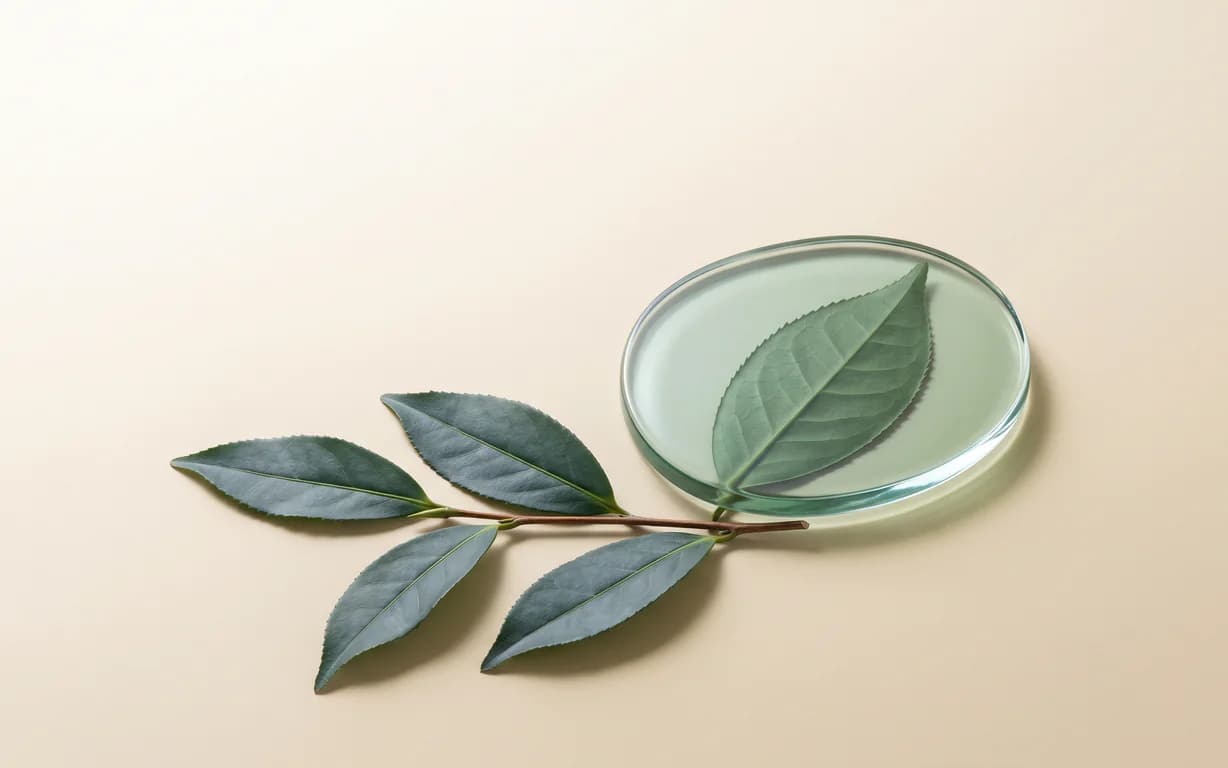
Pick the format that fills a gap in your routine: a toner, serum or moisturizer.
Apply a watery green tea toner after cleansing, then follow with serum and cream as needed.
Use a green tea serum before moisturizer, or let a green tea cream be your moisturizing step.
Follow the label for frequency and finish with sunscreen in the morning. Antioxidant skincare is an extra step alongside sun protection.
Choose green tea in the texture you enjoy, then build around everyday hydration and moisture-barrier care.
A useful companion when you want a routine for uneven tone or surface shine.
For a light, hydrating layer before moisturizer.
Help round out the routine with a comfortable moisturizing step.
Researchers compared a green tea emulsion with its base formula and untreated skin. With regular use, the green tea formula improved hydration and reduced surface roughness.
Another study followed the amount of oil on participants’ cheeks over eight weeks. Levels fell with the tested green tea formula.
A light green tea product may suit oily skin, and early research has found reductions in surface oil with a particular formula. Choose a comfortable texture rather than expecting every green tea product to control shine.
Many green tea toners and moisturizers are made for daily use. Follow the product’s directions and adjust if your skin feels uncomfortable.
No. Green tea comes from Camellia sinensis. Tea tree oil comes from Melaleuca alternifolia and is an aromatic essential oil. They have different roles and different ingredient-list names.
Recognized antioxidant and conditioning functions are supported by small human studies of particular green tea formulas for hydration, texture and surface oil.
The hydration study involved 24 volunteers and a 6% leaf-extract emulsion. The oil study involved ten men using a 3% formula. These studies do not establish the same effects for brewed tea, every extract, or separately listed leaf water and catechins.
Accessed 2026-09-18
Confirms the shared Camellia sinensis origin and differing preparation of green, black and oolong tea. Used for plant identity only; oral supplement claims are not transferred to skincare.
2013-05 · DOI 10.1111/j.1529-8019.2013.01552.x
A 24-person study of a 6% leaf-extract emulsion, with base-formula and untreated comparisons. Improvements concerned surface hydration and roughness; the extract’s preparation is not a recommendation to exfoliate with glycolic acid.
2010-08 · DOI 10.17305/bjbms.2010.2697
An eight-week study in ten men reported less cheek surface oil. The small study supports further research, not a guarantee of oil control from every green tea product.
EGCG is one catechin found in green tea. A leaf extract contains a mixture of compounds; a separately listed catechin is a different ingredient.
Brewed tea is not the same as a prepared and preserved cosmetic formula. The skincare studies here do not establish the same results from putting a homemade brew on your face.
A green tea toner or moisturizer can fit into the same routine. Follow the active product’s directions and introduce new products separately. Keep sunscreen as the final morning step.
2019-12-16 · DOI 10.1177/1091581819889914
Describes leaf-derived cosmetic ingredients, their composition and conditioning or antioxidant roles. Safety conclusions concern the reviewed uses and formulas designed to avoid sensitization.
2021-08-10
Dermatologists explain how to try a finished skincare product on a small area before using it more widely.
Find your next routine favourite
Start with one product that fits your routine.
Use at your serum step, before moisturizer. Choose this step when you want to keep the cream you already love, and follow the product's directions for how often to apply it.
Explore a serum or ampouleMake it part of your moisturizing step. Choose a cream for a richer finish or an emulsion for a lighter layer.
Explore a moisturizer8 productsSwipe to explore